
Fields in Suffolk Property Tax Records
Suffolk property tax records live in two places. The assessor parcel card carries the valuation side. The Treasurer's account handles charges and payment status. Knowing which office produced a field prevents confusion. That keeps clear the difference between what a parcel is worth and what its tax bill shows.
The Assessor's current Spatialest setup dates its assessment section 2026-2027. Reported fields include market land value, total improvement value, land-use value, and total assessed value. The split matters. An assessment figure should never be read as the amount due.
| Field | What It Shows | Where |
|---|---|---|
| Market Land Value | Land component shown on the assessment card | Spatialest Assessor card |
| Total Improvement Value | Improvement component of the assessment | Spatialest Assessor card |
| Land Use Value | Land-use assessment field, separate from market land value | Spatialest Assessor card |
| Total Assessed Value | Assessed amount used in the tax calculation | Assessor and Treasurer records |
| Bill and payment status | Account charges and payment information | Suffolk Treasurer portal |
| Taxing District | Citywide, Downtown, or Route 17 tax geography | Assessor card and city tax page |
The current card reads proposed 2026-2027 assessment. Its history holds ten annual value rows. A sale price shows up in transfer history, not as the assessed value. The City Treasurer applies the district tax rate to the assessed amount and tracks payments against the account. Read the label, year, and district together.
Suffolk's Assessment Year Starts July 1
Suffolk assesses real estate annually, with each assessment effective July 1. That date anchors every valuation. The City Assessor maintains parcel data and the land book, while the Treasurer handles billing and payment. The 2026-2027 Spatialest card is marked proposed. Its value details split into Market Land Value, Total Improvement Value, Land Use Value, and Total Assessed Value, so a reader can see which part of the record moved rather than treating the total as one unexplained number.
The Assessor's public page outlines the annual assessment program and lists tax-relief and land-use resources. The card also carries an exempt field. Eligibility rules vary by program. Ask the Assessor which application and supporting papers fit a specific parcel instead of guessing from the card.
The Suffolk assessment card on Spatialest shows the value and transfer fields behind a tax-record review. It names each value component separately. Transfer history appears there too.
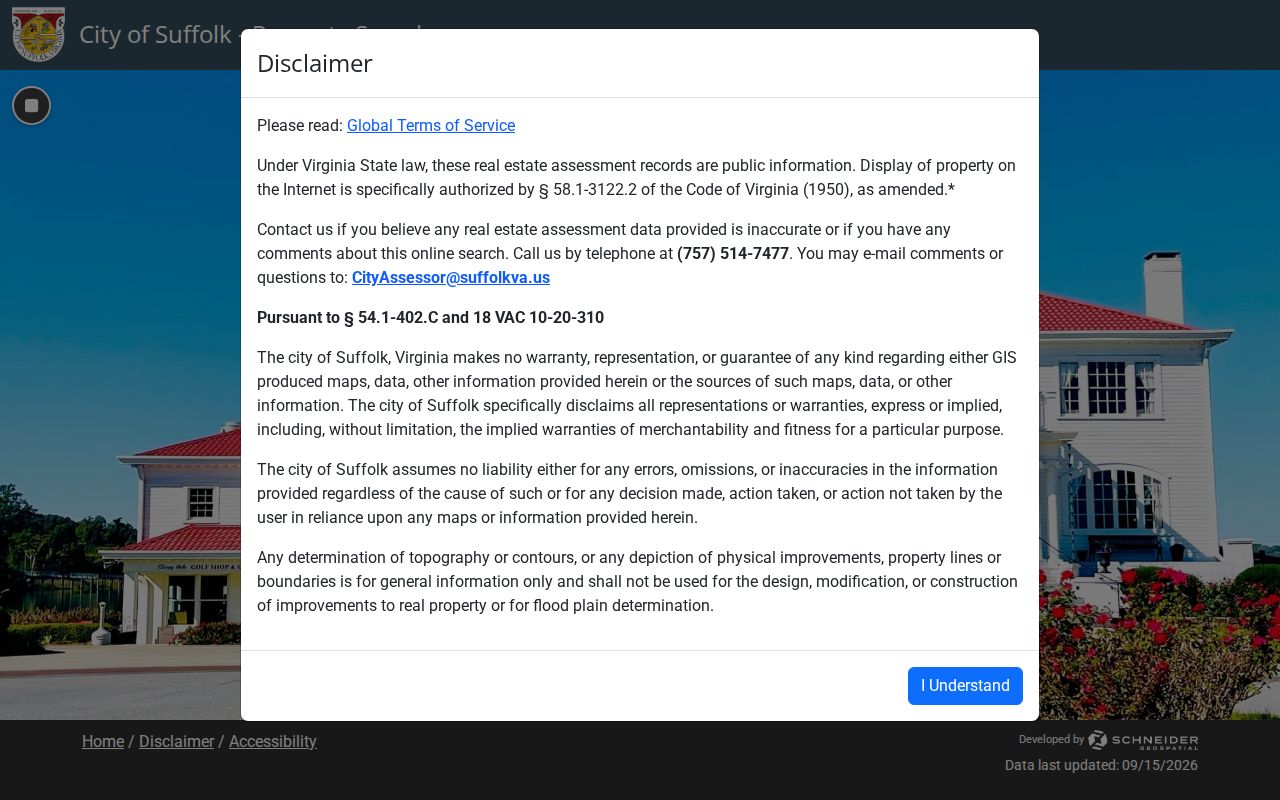
Read the year and each component first, before comparing this figure to a Treasurer bill.
Find a Suffolk Tax Bill by Parcel
The Suffolk Treasurer tax site handles online real-estate tax search and payment. An address match can be hard to pin down. When it is, copy the Account No. or Map No. straight from the Spatialest card. Use the exact displayed value. The portal's search controls may vary, so trust the labels on the current page. The Treasurer's office can answer account-specific questions.
- Open the Suffolk Treasurer tax portal and choose the available real-estate search path.
- Match the result to the address or assessor account number before reviewing the bill.
- Read the tax year, amount due, and payment status shown for that account.
- Contact the Treasurer to resolve a delinquency or payment mismatch; use the Clerk index for any separate recorded lien.
- Assessed value
- The Assessor's annual taxable value for the parcel, shown separately from sale price.
- Tax rate
- The amount charged for each $100 of assessed value in the parcel's taxing district.
- Tax account
- The Treasurer's bill and payment record associated with a property account.
- Tax lien
- A recorded claim tied to unpaid tax; confirm the account with the Treasurer and the instrument with the Clerk.
Contest a Suffolk Assessment With Evidence
Suffolk's 2026-2027 Board of Equalization application provides three review bases: the parcel is assessed above or below fair market value for January 1; it is not equitably assessed against comparable properties; or the assessment uses inaccurate property information. The form asks for a separate application for each separately assessed parcel and for Account No. and Tax Map Number. If an agent files, the form calls for a Suffolk Agent Authorization form.
Evidence depends on the reason. The form provides spaces for comparable sale price, account number, and property address for a market-value claim; comparable account, address, and total value for an equity claim; and a description of inaccurate data, such as wrong square footage, for a property-information claim. The form says electronic submissions with supporting material are welcome, but the original signed application must be submitted before or at a Board hearing.
2026-2027 appeal date. The form sets May 1, 2026 as the filing deadline for review of the January 1, 2026 valuation. That date has passed; ask the Assessor or Board for the next cycle's current form and calendar.
Suffolk Tax Payments Have Two Installments
Suffolk collects real-estate tax in two installments. The due dates are June 5 and December 5. Pay at the Downtown office, 442 W Washington Street, or the North Suffolk office, 2000 Bennetts Creek Park Road. The Treasurer's number is 757-514-4275. Card and electronic-check payments carry no convenience fee.
The Suffolk real-estate tax page lists the due dates and office details. Check the account bill first, since a due date belongs to the tax year and account shown.
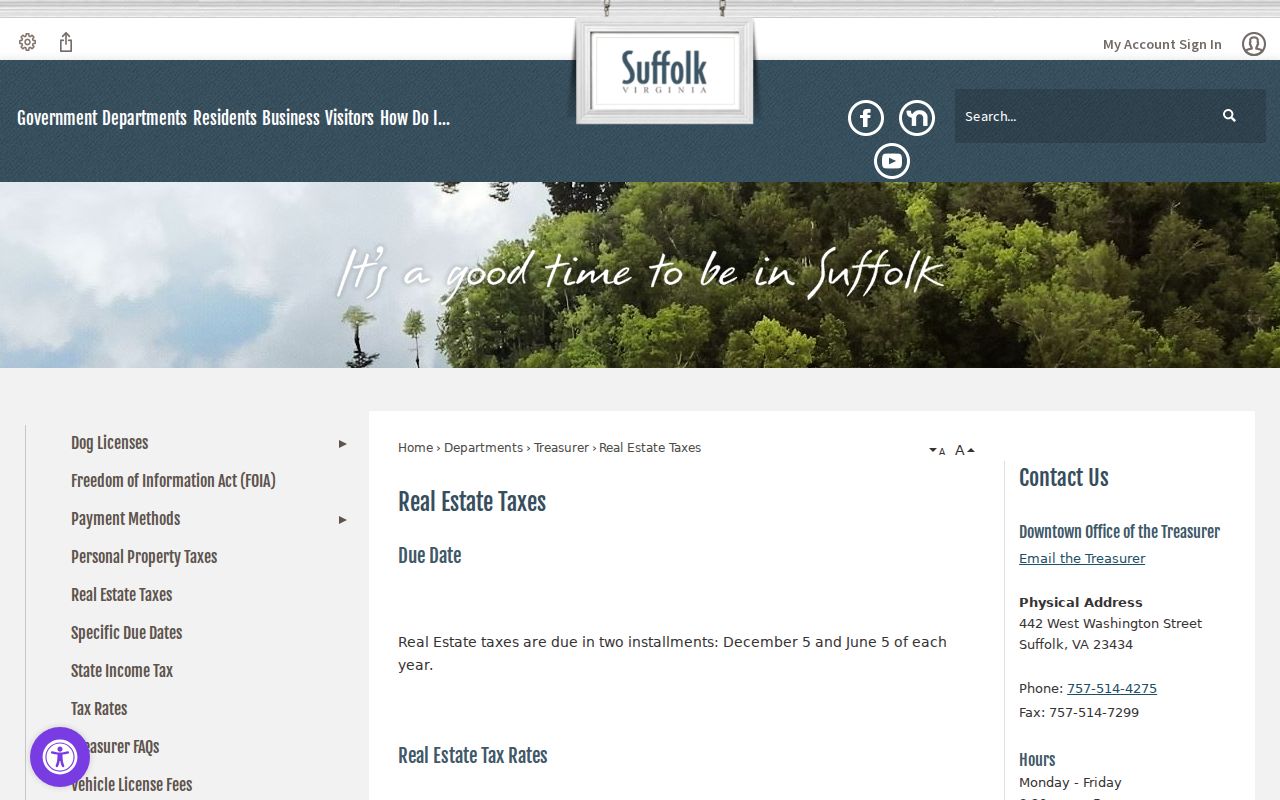
Keep a payment confirmation with the parcel's tax-year record when reconciling a past bill.
Suffolk Tax Districts Use Different Rates
Suffolk's published real-estate rates run through June 30, 2027. The citywide rate is $1.06 per $100. Downtown Business District pays $1.165 per $100 of assessed value, and the Route 17 Taxing District pays $1.30. A district rate changes the tax math, never the market value. Check the Taxing District field on the assessor card to see which rate applies.
The Suffolk Treasurer tax portal handles account search and payment. Use the current portal labels. If an account match is unclear, contact the Treasurer.
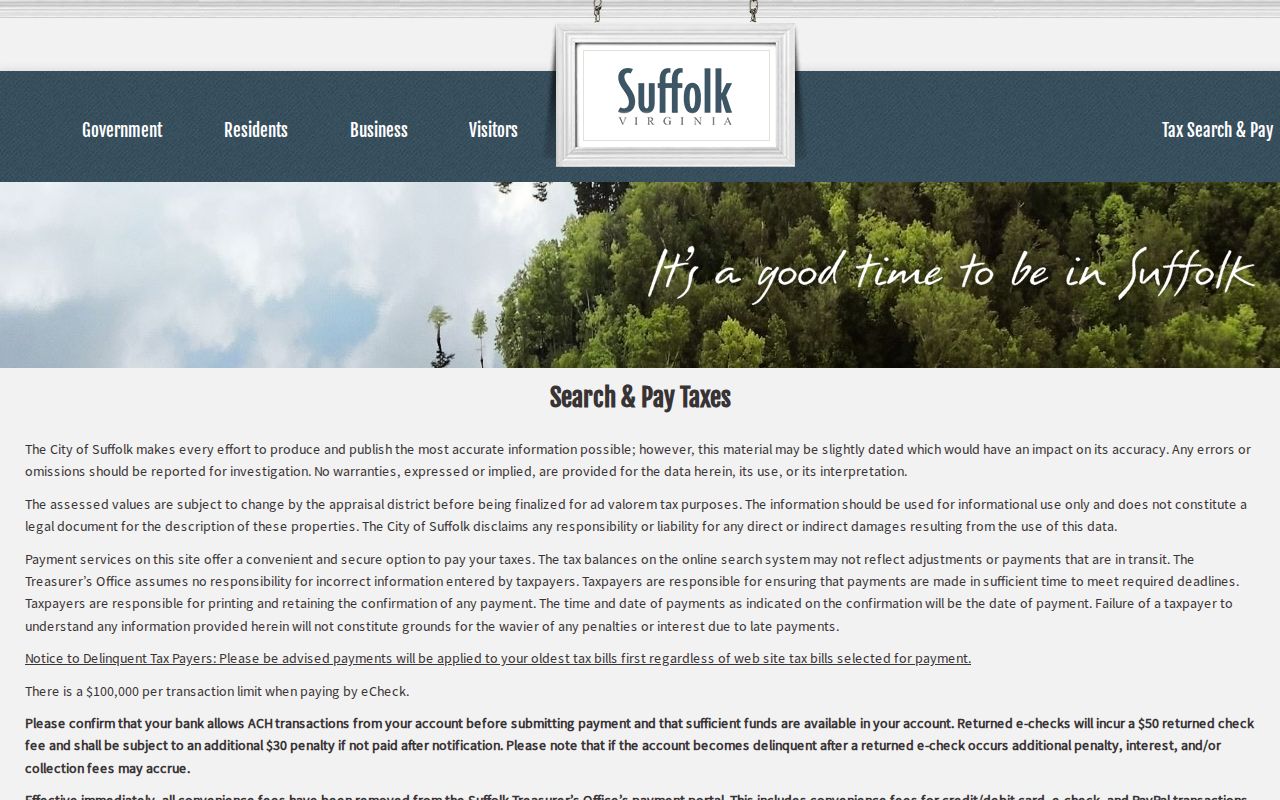
Read the rate, assessed value, land-use treatment, and bill status from their own labeled fields.
Suffolk Relief and Land-Use Fields Need Review
Suffolk's Real Estate Assessor handles assessments, tax-relief information, and the land-use program. The Spatialest land detail carries an exempt field and a land-use value. Its assessment section splits that value from market land and improvement figures. Read these fields as clues. They show how the account is treated, not full program rules or an eligibility result.
For an application, ask the Assessor about relief and land-use forms. Ask what proof to bring. The office sits at 442 W Washington Street, and the number is 757-514-7475. A change in the exempt or land-use field can move the assessed or taxable amount. It never alters the deed, the boundary, or the sale price recorded for the parcel in Suffolk property records.
Assessment and Sale Price Are Different Numbers
One Suffolk card can list market land value, improvement value, land-use value, and total assessed value. It can also show a transfer sale price. Related numbers, but hardly the same. A sale price reflects the consideration recorded for a transfer. The annual assessment drives the tax roll. The Treasurer's bill layers district rates and account charges on top. What the assessment means differs from what the bill collects. To separate them, use the Suffolk property value comparison.
Transfer history in the deed records also flags transactions. It marks them qualified or unqualified, improved or vacant. Those labels show how the Assessor reads a transfer within the parcel history. They do not set market value for a later date. Weigh the property details, the year, and the recorded instrument. Do this before leaning on one sale in an appeal.
Suffolk Delinquency Has a Separate Record Trail
A past-due Treasurer balance, a recorded tax lien, and a finished tax sale are three different events in Suffolk property tax records. Start with the Treasurer. That office holds the account balance and payment status. Then check the Circuit Court Clerk's SRA index for a recorded lien or notice. Pull the court file for any linked case. A delinquent account alone proves neither a sale nor a change in the owner of record.
A 2017 city tax notice set a 10 percent penalty plus 10 percent annual interest. Older finance material described a lien after three years of unpaid real-estate taxes. Treat those as dated figures, not a current bill. Confirm today's penalties, interest, lien status, and any sale calendar with the Treasurer before relying on an old notice.
Separate Suffolk Assessment and Treasurer Questions
Suffolk's City Assessor and Treasurer keep related but separate records. The Assessor sets parcel characteristics and value fields. The Treasurer runs the real estate tax accounts, bills, receipts, and balances. Assessed acreage or an improvement record? That question goes to the Assessor. Did an installment post? What remains due, or how should a payment be applied? Those questions belong with the Treasurer.
The Assessor card can show current and proposed values. It also lists land and improvement components, plus a limited assessment history. Use those fields to understand the tax calculation's basis. They will not tell you whether a bill was paid. A Treasurer balance, in turn, sets neither market value nor the legal owner of record. Keep the account number and bill year handy when calling either office.
Suffolk's Downtown Treasurer service point is at 442 W Washington Street. The North Suffolk location is at 2000 Bennetts Creek Park Road. The Treasurer number is 757-514-4275. The Assessor sits at 442 W Washington Street, 757-514-7475. Check the current City page for payment options, office hours, and service changes.
Verify the Suffolk Taxing District Before Comparing Bills
Real estate tax rates in Suffolk differ by district. The general city, Downtown Business District, and Route 17 Taxing District each carry their own published rate: $1.06, $1.165, and $1.30 per $100 of assessed value, respectively, through June 30, 2027. Those figures are district rates, not estimates of what a property is worth. Before comparing two bills, confirm the taxing-district field on the parcel record matches. Otherwise the comparison means nothing.
Estimating a bill is straightforward. Multiply the taxable assessed value by the rate per $100 that fits the district, then apply any adjustment or credit. Never borrow a neighbor's rate for your own parcel unless the district fields agree. The calendar matters too. Suffolk real estate bills come due June 5 and December 5. And a value tied to a proposed assessment cycle is not necessarily the final taxable figure, so check the City notice and the year before assuming it is.
An unexpected bill deserves a closer look. Pull the property account, assessment year, district, and posted payments apart, one at a time. The Treasurer handles questions about the tax account itself. The Assessor is the right office for the underlying value or parcel data. Splitting the question this way gives you a more precise answer than treating a higher bill as proof the property's value rose by the same amount.