
What Suffolk Deed Records Contain
The Land Records Division of the Suffolk Circuit Court Clerk records deeds, deeds of trust, plats, liens, releases, judgments, and other land instruments. A deed records a transfer or another stated interest. A deed of trust records secured debt. Releases and satisfactions document later events tied to that debt. Each type tells its own story. A recorded instrument is an official record of what was filed, not a full title opinion, and it does not prove that no unrecorded interest exists.
| Deed Type | What It Does | Common Use |
|---|---|---|
| Deed | Records a conveyance or other stated land interest | Trace a transfer or confirm parties |
| Deed of trust | Records a security instrument against property | Review a recorded loan instrument |
| Release or satisfaction | Records that a listed obligation was released or satisfied | Match to the earlier instrument |
| Easement or right-of-way | Records a use right affecting described land | Read access and utility references |
| Plat or subdivision map | Records a lot layout and related notes | Confirm lot, block, and dedication details |
| Mechanics lien, judgment lien, or lis pendens | Indexes a claim or pending property action | Follow the land record to the court file |
Document type matters. A lien or a pending case can burden a parcel without moving title. A release must match the debt it addresses. Judgments, deeds of trust, and plats work differently. So treat these as families of instruments rather than a fixed menu of choices.
Virginia SRA Separates the Index from the Image
The Virginia Courts Secure Remote Access system, known as SRA or COVERS, is the remote route to land records kept by circuit clerks. A free index-only view may be available when the local court enables it. Document images are another matter. They require an SRA subscription authorized by the Suffolk Clerk. This split matters in practice. A search result can prove that an indexed instrument exists. The full wording still sits behind an access step. Start at the Virginia SRA land-record portal, the system's entry point. From there you can hunt for the deed reference you need.
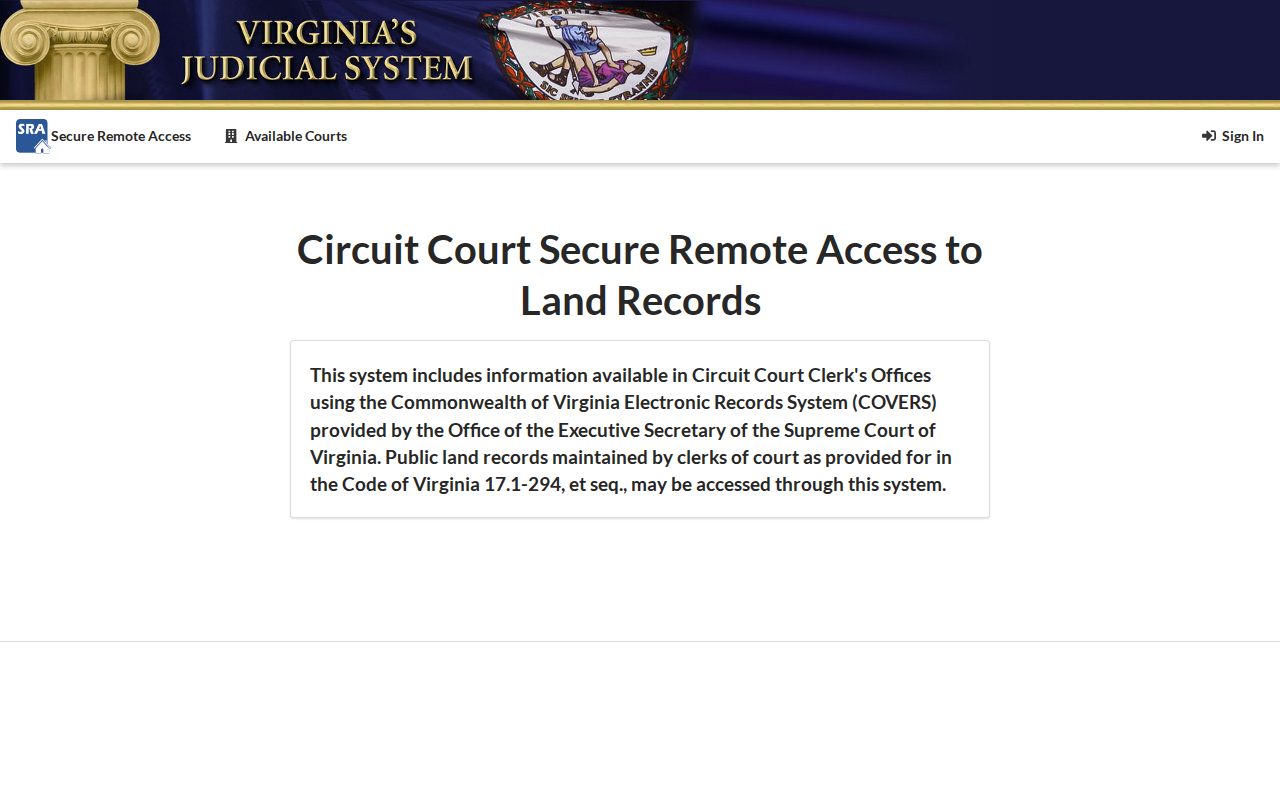
Use the portal to spot a candidate reference. Then ask the Clerk about image access or a counter copy when the text is not available online.
Suffolk's Online Deed Cutoff Is Not Published
The Clerk's public page does not state the first year in Suffolk's online index. It does not cover the image collection either. The online property card does not publish the SRA cutoff either. That silence matters. Do not borrow a start year from a neighboring court. Never assume an old book is digitized just because a newer deed appears online. When a chain stops, ask Land Records to check the local index. It can also pull vault books and any available SRA route. An index search and an image are separate products. Subscription rules are set with the local court. Confirm certified-copy fees directly with the Clerk. The online index is a finding aid. It is not a promise that every historical instrument opens from home.
Search Suffolk's Grantor and Grantee Names
The Circuit Court Clerk records each instrument. Virginia SRA and COVERS supply the remote search route. A grantor is the party shown as transferring an interest. A grantee is shown as receiving it. Chain building works in both directions. To move forward, search the current grantee or owner and find the matching deed. To move backward, take the grantor named in that instrument. Look for the earlier deed by which that party acquired the parcel.
- Start with the assessor's current Owner field or a deed reference from the Spatialest transfer history.
- Search that party as grantee and identify the instrument that matches the parcel description.
- Read the deed's grantor, recording reference, and legal description before moving to the prior transfer.
- Use the prior grantor as the next grantee search and repeat, checking every instrument against the land description.
- Grantor
- The party conveying an interest in the instrument.
- Grantee
- The party receiving an interest under the instrument.
- Chain of title
- The linked sequence of recorded transfers for the same land.
- Book/page or instrument number
- A recording reference shown in the assessor transfer history or clerk record; copy it exactly.
Match Suffolk Instrument References Before Reading
A deed index result still needs a parcel match. Compare party names, book and page or instrument number, recording date, document type, and legal description against the assessor's transfer history. The Spatialest card can list Sale No., Book, Page, Instrument No., Sale Date, Sale Price, qualification, improved or vacant status, and comments. The clerk image carries the operative wording. Card summaries omit it. Do not treat any column list as fixed. The clerk's current interface controls which fields appear. Plan around the likely party and placement clues. Ambiguity happens. When a result is unclear, contact the Land Records Division with the parcel key, name variants, and an approximate date range. That level of detail lets staff find the entry fast.
Suffolk Releases Must Match the Earlier Instrument
A newer deed does not by itself show that a deed of trust, judgment lien, easement, or other recorded burden ended. Search the release, certificate of satisfaction, assignment, correction, or re-recording on its own. Match its reference to the earlier instrument. Read the legal description too. A tax delinquency account belongs with the Treasurer. A recorded lien and its release belong in the land-record index. Other cases leave traces in both records. A lis pendens is an indexed notice tied to litigation. The case file may hold the complaint, order, or disposition. A docket hit must be checked against the parcel description. A mechanics-lien or property-line case may need the Circuit Court file. It may also need the recorded instrument.
Older Suffolk Deeds Use Predecessor Localities
Suffolk consolidated in 1974. Before that, the same land might sit under Nansemond County, City of Nansemond, Suffolk, Holland, or Whaleyville. A modern mailing address is a weak key for those older volumes. Search by party name and legal description instead. Keep the locality label exactly as printed on the instrument. An old Holland or Whaleyville town lot, for example, may carry a village reference. That reference never made it onto today's assessor card.
The Library of Virginia's Nansemond collection holds both microfilm and original records. Its catalog helps you pin down the right reel or book. It does so when SRA does not reach the year you need. When you contact the archive, bring the predecessor locality name and any book reference. Staff can then pull the correct series.
The 1837 Fire Left Gaps in Suffolk Deed History
Suffolk's own historical account describes the 1837 Great Fire. It destroyed the courthouse, the clerk's offices, and most vital records. Early gaps in the deed record are therefore a documented local loss. They are not evidence that a transfer never happened. A later instrument may even cite a predecessor deed that is now hard to locate. Check the Clerk and the Library of Virginia for surviving, reconstructed, or successor records.
One concrete lead exists. The Library of Virginia's preservation list names Suffolk City Deed Book 34. It covers 1893 to 1895. The Nansemond microfilm catalog identifies the predecessor collection and how to reach it.
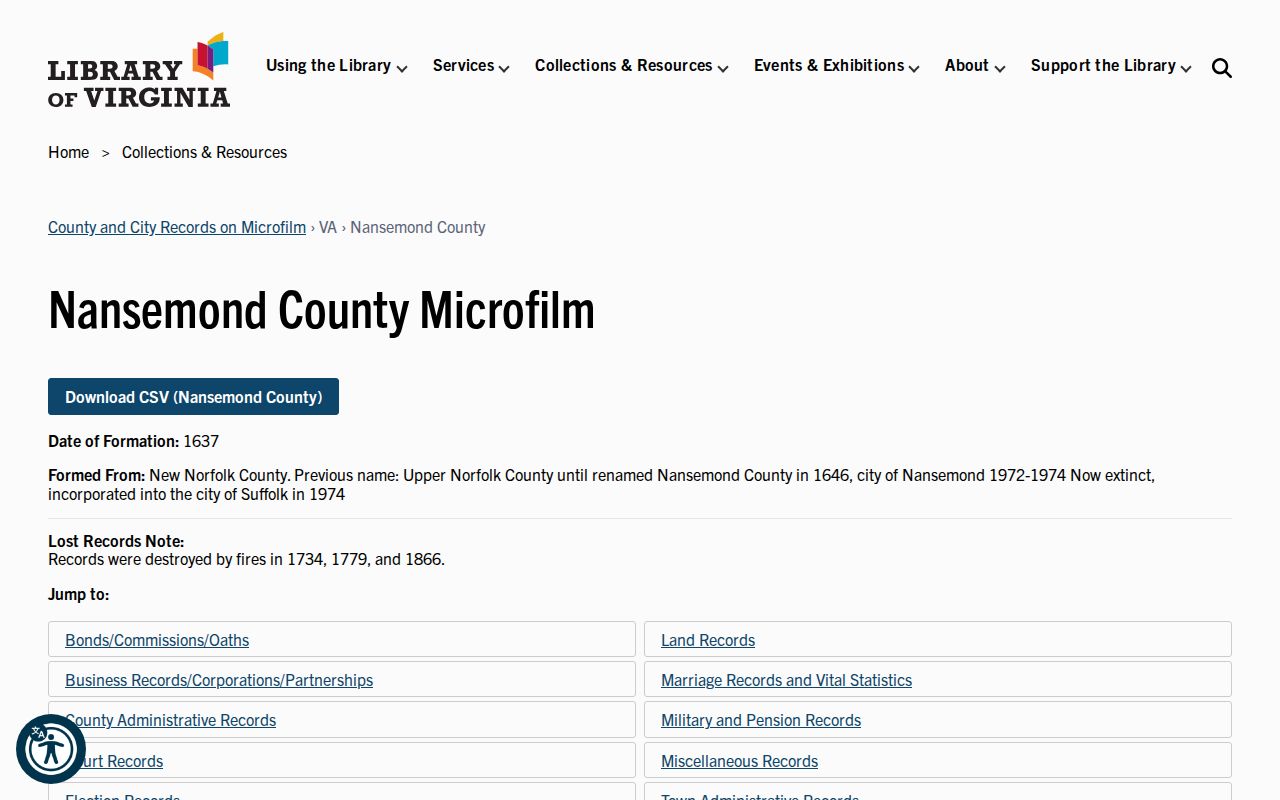
When you chase an older Suffolk chain, lean on the collection name, the prior owner of record, and the legal description as your search keys.
Request a Suffolk Recorded Deed
Virginia SRA can expose an index and, where local settings permit, deed images. The public Clerk page does not state Suffolk's online coverage. Image subscription authorization rests with the Clerk. So a visible index hit does not guarantee an open document image. For a certified or clerk-held copy, call Land Records at 757-514-7812 and ask which request method applies. The Clerk publishes no copy price. So confirm the current fee by phone.
The counter sits in the Mills E. Godwin Courts Building at 150 N Main Street, Suffolk, VA 23434. Land Records keeps weekday hours of 8:30 a.m. to 5 p.m. Monetary transactions stop after 4:30 p.m. Filings go in person, by mail, or by e-filing. Starting September 1, 2026, fax and email are no longer accepted for pleadings, orders, and documents. A public copy request is a separate matter. So confirm its current channel with Land Records.
Recorded, not guaranteed. Suffolk deed records show instruments filed with the Clerk. They do not establish that every interest was recorded or guarantee clear title. Match the legal description and consult a title professional when a title conclusion is needed.
Plan a Suffolk Circuit Court Clerk Visit
The Circuit Court Clerk keeps land records at 150 N Main Street, Suffolk, VA 23434. Weekday hours run 8:30 a.m. to 5:00 p.m., with no monetary transactions after 4:30 p.m. The land-record division answers at 757-514-7812; the general Clerk number is 757-514-7800. Call ahead about access and payment. This matters most if you need an image, certified copy, or another service beyond a basic index lookup.
Bring every locating detail you have. That means grantor and grantee names, an approximate deed date, book and page or instrument number, and the legal description. A parcel address alone may fall short for an older instrument. Both the address and the locality name may have changed. Ask whether the volume you need is on hand and what copy format and fee apply. The published online materials give no single cutoff year or fee schedule for every record type.
Virginia SRA may offer a free index search, while document images require Clerk-authorized subscription access. Do not assume a search result link opens a full Suffolk image without that authorization. If an image will not display, use its reference. Ask the Clerk about an authorized access or copy route.
Check a Suffolk Deed Chain for Gaps
A Suffolk deed chain holds up when each transfer links the prior grantee to the next grantor. It should also describe the same land. Compare the full legal description, exceptions, reservations, and any plat reference. Do not trust a shared surname. Watch for partial interests, estate conveyances, trustee transfers, and subdivisions. Any of these can add parties that look nothing like a simple sale.
A later deed's recitals and book/page references point backward to earlier instruments. If the chain hits a gap, search the predecessor locality. Ask the Clerk or Library of Virginia which older index or series fits. Records now tied to Suffolk can carry Nansemond County, City of Nansemond, Holland, or Whaleyville names. The 1837 fire destroyed most courthouse and vital records. So an early missing deed may reflect a documented loss. Do not extend that history to later deed books, which stand on different footing.
Write down the exact sources you reviewed and what remains open. A property-records search can assemble a chronology. But it cannot certify marketable title or rule out a competing interest. Leave any transaction or legal conclusion to a title professional.